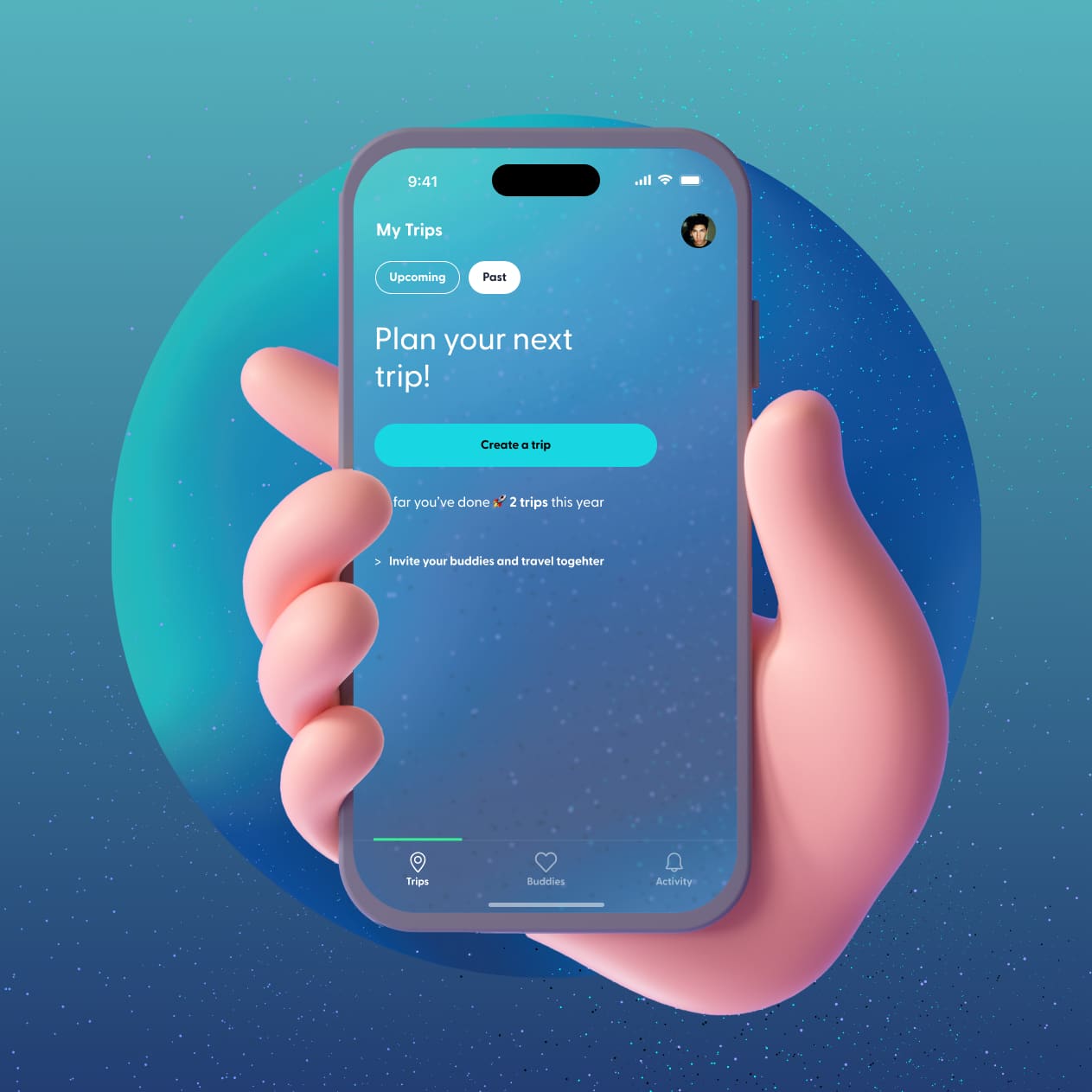


The Circle app has become one of the world’s most popular white-label community platforms for membership businesses. Thousands of organizations use it to create branded member experiences without the cost and complexity of building a custom app from scratch. But as membership businesses grow, an important question begins to emerge: Is the Circle app still the right platform, or is it time to invest in a custom membership app and membership software designed around your business?
The new era of membership businesses
Membership businesses have changed dramatically over the past decade. What was once little more than a website and a newsletter has evolved into a fully digital member experience, where everything from discovering other members and booking events to reading content and managing memberships happens inside a mobile app.
One organization that has helped shape those expectations is Soho House. Its app has become one of the most recognized digital experiences in the membership industry, inspiring private members clubs, professional networks, alumni associations and community businesses around the world to ask the same question:
“How can we build an app like that?”
For most organizations, the answer isn’t to hire a team of designers and engineers to build a custom platform from day one. Instead, they begin looking for a solution that is faster, more affordable and already proven. That’s where Circle enters the conversation.
For thousands of organizations, it has become the fastest way to launch a branded member experience without investing in custom software. It enables businesses to launch discussions, events, memberships, courses and mobile apps in a matter of weeks rather than months—making it an ideal starting point for many growing membership businesses.
But what happens when your community grows?
The challenge isn’t that Circle changes — it’s that successful communities do.
As member expectations evolve, communities often become membership businesses with increasingly complex needs. They require more personalized onboarding, deeper integrations, operational workflows, custom member journeys and digital experiences that reflect their own brand rather than the framework of a shared white-label platform.
Over the past few years, we’ve worked with a growing number of membership organizations exploring whether to continue using Circle or invest in a custom community platform. As part of that process, we carried out an in-depth analysis of Circle — not just from our own perspective as product designers and engineers, but from the perspective of the people using it every day.
We interviewed 10 organizations actively using Circle, reviewed their experiences, and combined those insights with our experience designing digital products for membership organizations. We’d like to share what we learned to help others understand where Circle excels, where it starts to reach its limits, and how to recognize whether it’s still the right platform for the stage their community is in.
Why so many membership businesses want an app like Soho House
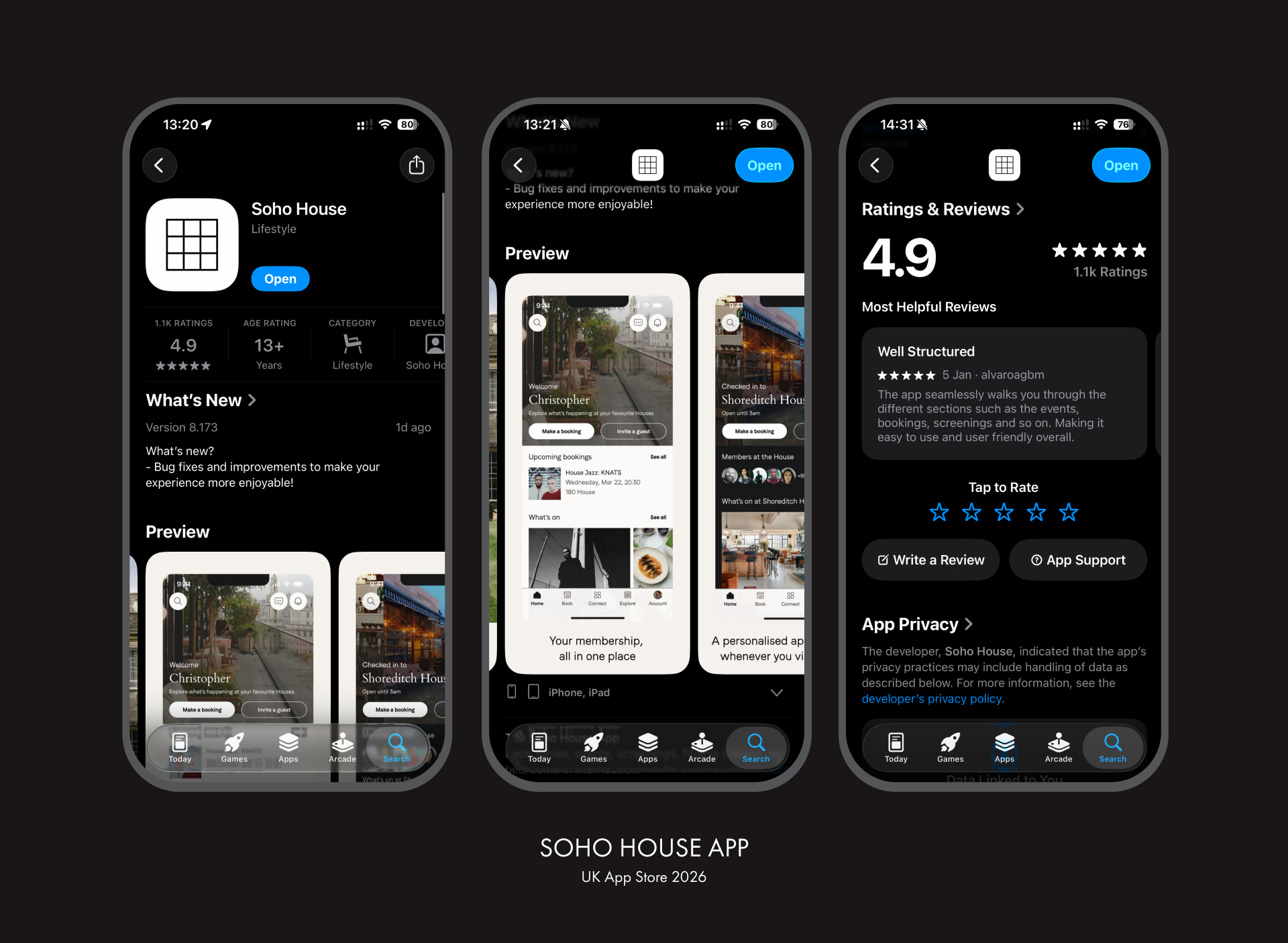
In the last 10 years, Soho House has become one of the most influential brands in the membership industry—not just because of its physical Houses, but because of the digital experience it has built around them. Its app has redefined what members expect from a modern membership business, bringing together everything from events and bookings to member discovery, wellness, editorial content and exclusive experiences in one seamless platform.
As of the latest publicly available figures, Soho House & Co serves more than 271,500 (Soho House, Form 10-K, 2025) members worldwide, alongside a broader membership ecosystem spanning multiple brands. For many organizations, this has become the benchmark for what a premium membership app should feel like.
It’s no surprise that private members clubs, professional networks, alumni associations, business communities and subscription-based memberships frequently ask the same question:
“How can we build an app like Soho House?”
The answer, however, is rarely to build a custom app from day one.
For most organizations, launching a bespoke digital platform requires a significant investment of time, budget and technical expertise. Before committing to that journey, many choose to validate their concept, grow their membership and better understand what their community actually needs.
That’s where platforms like Circle have become incredibly popular.
Rather than spending months building software from scratch, organizations can launch a branded community in a matter of weeks, giving members a place to connect, discover events, join discussions and begin building an engaged community. For many membership businesses, it’s the perfect first step toward creating a digital member experience.
The important question isn’t whether Circle is a good platform. The real question is whether it will continue to meet your needs as your community evolves from simply connecting members to operating an increasingly sophisticated membership business.
Why so many membership businesses choose the Circle app
Circle is a cloud-based community platform that enables organizations to create branded digital communities without building a custom community app from scratch. It brings together discussions, member profiles, events, groups, courses, memberships and mobile apps into a single platform, allowing businesses to launch a digital member experience considerably faster than developing their own solution.
When researching community platforms, it’s almost impossible not to come across the Circle app. Launched in early 2020, over the last few years, it has established itself as one of the best-known platforms for organizations looking to build a digital community without investing in custom software from day one.
At the time of writing, the Circle app combines many of the features that membership businesses typically need into a single platform, including community discussions, member profiles, events, groups, courses, subscriptions and mobile apps. Instead of designing and developing each of these capabilities from scratch, organizations can configure an existing platform, apply their branding and launch considerably faster than they could with a custom-built solution.
For many communities, that’s exactly the right approach.
Launching a new membership business comes with enough uncertainty already. Before investing significant time and budget into building a bespoke digital product, many organizations simply want to validate that members will engage, attend events, participate in discussions and find value in the overall experience.
Based on the organizations we interviewed, Circle provides a relatively low-risk way to validate those assumptions without the cost and complexity of building custom software.
Throughout our research, we found that this was one of the main reasons organizations initially chose Circle. It allowed them to launch quickly, understand how their members behaved and learn which features actually mattered before considering whether investing in a custom platform made business sense.
Where does the Circle app work best
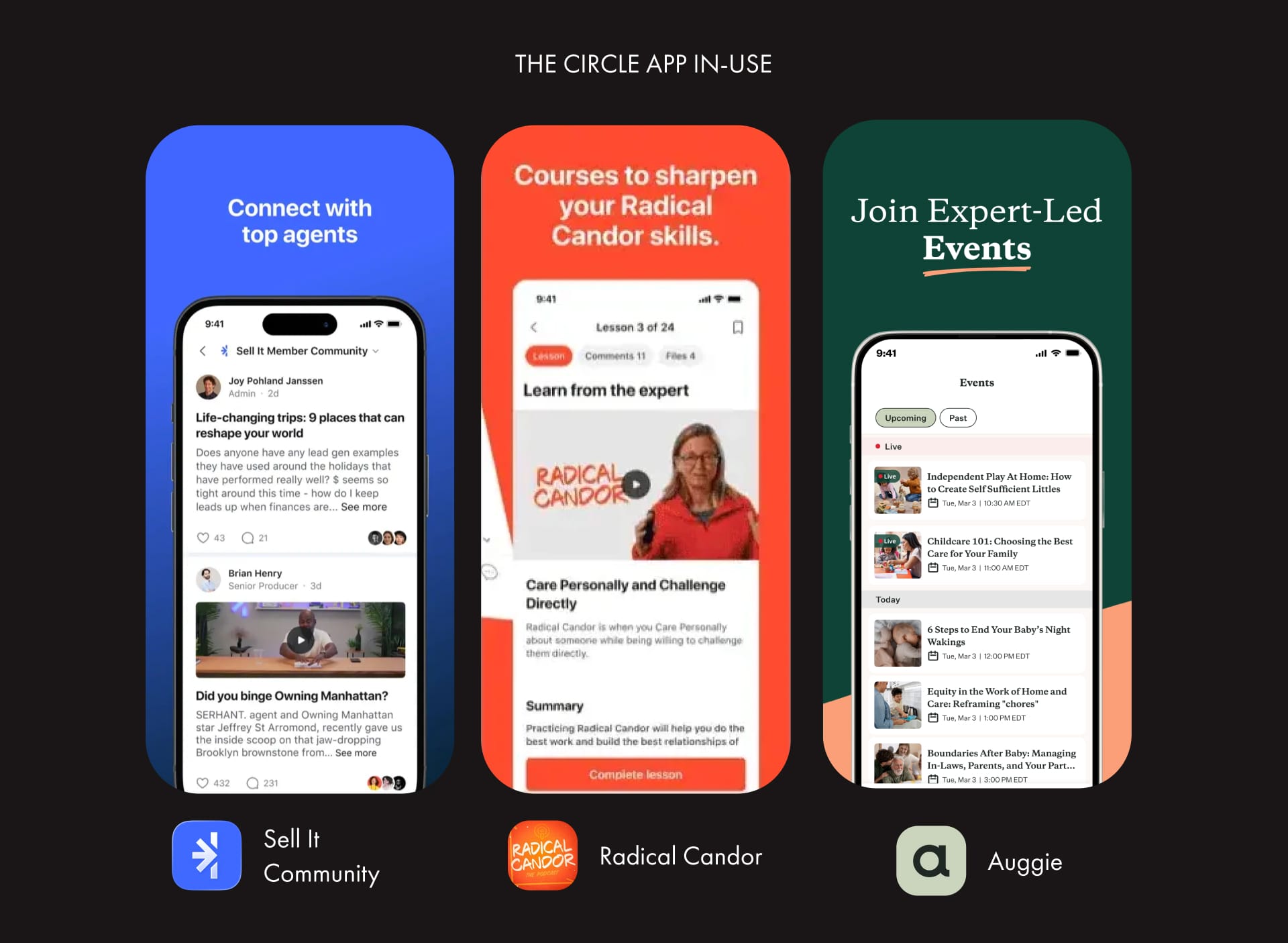
One thing became clear throughout our research: Circle works best when the goal is to launch and grow a community without the complexity of building custom software.
The organizations we interviewed weren’t looking for a unique digital product from day one. They wanted to bring members together, validate their concept and understand how people engaged before making a significant investment in technology. Based on our research, the Circle app supports that journey well.
It provides many of the features membership businesses need to get started, including discussions, events, groups, member profiles, courses and mobile apps, all within a single platform. Instead of spending months defining requirements, designing interfaces and developing software, organizations can focus on growing their membership and learning what their community actually values.
This is particularly valuable during the early stages of a membership business. At that point, member feedback is often more important than perfect technology. Launching quickly allows organizations to observe how members interact, which features they use, what creates engagement and where improvements are needed.
Several of the organizations we interviewed described the Circle app as the platform that gave them the confidence to launch. Rather than delaying their business while building a custom solution, they were able to establish a digital presence, grow their community and gather real-world insights before deciding what should come next.
For organizations whose priorities are launching quickly, validating an idea and building an engaged community, Circle can be a very effective solution.
As long as those priorities remain the same, many communities will find that the Circle app continues to meet their needs.
But, what happens when your membership business begins to evolve?
When does the Circle app start reaching its limits
Every organization we interviewed had one thing in common: they chose the Circle app because it solved the problems they had at the time.
None of them started their journey looking for a custom-built platform. However, as their membership businesses grew, so did the role technology played within them. What began as a platform for conversations, events and member engagement gradually became something much bigger. Technology was no longer just supporting the community — it was becoming part of the member experience and an increasingly important part of the business itself.
This was the point where many organizations began asking different questions.
Instead of asking, “How do we launch our community?”, organizations began asking “How do we build the best possible experience for our members?”
As their businesses matured, technology was no longer just about providing a place for members to connect. It became a strategic tool for increasing member engagement, improving retention, creating new revenue opportunities and streamlining day-to-day operations.
These aren’t shortcomings unique to the Circle app. They’re challenges that naturally emerge as membership businesses grow, regardless of the platform they’re using. Across the organizations we interviewed, the same themes appeared repeatedly. Businesses weren’t necessarily asking for more features — they were asking for greater control over how their technology supported their brand, their members and their operations.
Branding & Identity
One of the most common themes we heard was that organizations eventually wanted their technology to feel like an extension of their brand rather than an extension of the platform they were using. For many communities, adding a logo, colors and brand imagery is enough in the early stages. As businesses mature, however, they often want complete control over the visual identity, interactions and overall experience. They want members to feel like they’re using their app—not simply a branded version of someone else’s product.
Member Onboarding
Member onboarding was another area that came up repeatedly. Many organizations wanted onboarding journeys that reflected their own membership process rather than a standard flow. They wanted to ask custom questions, collect information over multiple steps, introduce benefits gradually and personalize the experience based on membership type.
As first impressions become increasingly important, businesses often look for onboarding experiences that are unique to their brand and their members.
“We wanted a multi-step onboarding journey to collect member information, but couldn’t build it the way we envisioned.”
Homepage & Navigation
As communities grow, the homepage often becomes more than just a place to display recent activity. Organizations wanted to surface important information, promote events, highlight benefits, recommend content and personalize what different types of members see. They also wanted greater flexibility over navigation so the app reflected how their business worked rather than the structure of the underlying platform.
“The homepage became one of our biggest frustrations. We couldn’t prioritize the content we wanted members to see.”
Community Experience
Circle provides a strong foundation for discussions and community engagement. Over time, however, some organizations wanted to shape the experience around the specific ways their members interacted. This included creating unique engagement mechanics, supporting different membership tiers, encouraging networking in different ways and designing experiences that reflected their own community rather than a standardized model.
Integrations
Very few membership businesses operate using a single piece of software. As organizations grow, they often introduce CRMs, payment providers, booking systems, marketing platforms and other operational tools. Several organizations told us they wanted these systems to work together more seamlessly rather than relying on multiple disconnected workflows or third-party integrations.
Product Roadmap
One of the realities of using any white-label platform is that the product roadmap is shared across thousands of customers. Several organizations mentioned features they would have liked to see but understood that development priorities needed to balance the needs of a much broader customer base. For businesses with highly specific requirements, waiting for platform updates can eventually become a limitation.
Analytics & Reporting
As membership businesses mature, understanding member behavior becomes increasingly important. Organizations wanted deeper insights into engagement, retention, event participation, content performance and member journeys—not simply to measure activity, but to make better business decisions. They also wanted reporting tailored to the metrics that mattered most to their own organization.
Operational Workflows
Perhaps the biggest shift we observed was that many organizations were no longer looking for just a community platform. They wanted technology that also supported the day-to-day operation of their business—from membership management and event operations to bookings, payments, staff workflows and administrative tasks. As these operational needs grew, many found themselves using multiple separate systems alongside Circle.
Member Data & Ownership
Several organizations also spoke about the importance of owning their member experience and having greater control over how member data was structured, managed and connected across their wider technology ecosystem. As businesses become more data-driven, flexibility around how information is collected, stored and used often becomes increasingly valuable, particularly when integrating with other business systems.
Five signs your membership business may have outgrown the Circle app
Outgrowing Circle isn’t about reaching a certain number of members or years in business. Many successful organizations continue using it for a long time. Instead, it’s usually a gradual shift. As your membership business evolves, you begin noticing recurring challenges that weren’t there when you first launched. If several of the following signs sound familiar, it may be worth considering whether your technology is still aligned with where your business is today.
Sign #1: You’re building workarounds.
One of the clearest indicators is when your team starts creating manual processes to work around the platform rather than working with it.
Perhaps you’re using spreadsheets to track information, relying on multiple Zapier automations, asking members to complete forms outside the app or directing them to different systems to complete simple tasks. Occasional workarounds are normal. When they become part of your everyday operations, it’s often a sign that your business has evolved beyond what your platform was originally designed to support.
Sign #2: Members are asking for features you can’t provide.
As your community grows, member expectations grow with it.
You may begin receiving requests for better onboarding, personalized homepages, member directories, networking features, event reminders, booking capabilities, loyalty programs or other experiences that would genuinely improve engagement. The issue isn’t necessarily that these ideas are impossible — it’s that your ability to deliver them depends on the capabilities and priorities of the platform you’re using.
Sign #3: Your technology no longer reflects your brand.
Your website, marketing and member experience may have evolved significantly, while your app still feels constrained by the framework of a shared platform.
For many organizations, the app eventually becomes one of the most important touchpoints with members. At that stage, businesses often want every screen, interaction and journey to reflect their own identity rather than the structure of a white-label product.
Sign #4: You’re paying for multiple disconnected tools.
What started as a single community platform gradually becomes a collection of separate systems.
You add one tool for forms, another for bookings, another for CRM, another for payments, another for analytics and another for email marketing. Individually, each tool solves a problem. Collectively, they create complexity, duplicate work and a fragmented experience for both members and staff.
Sign #5: Your roadmap depends on someone else’s priorities.
Every software platform has a product roadmap, and those roadmaps are designed to balance the needs of thousands of customers.
If your business depends on functionality that isn’t currently available, you may find yourself waiting months — or longer — for a feature that may never become a priority. For growing membership businesses, this is often the moment they begin asking whether their technology should evolve alongside their business rather than the other way around.
What Problems does a custom membership app solve?
A custom app isn’t about adding more features — it’s about removing the compromises that come with a shared platform.
Instead of adapting your business to fit the software, the software is designed around your business, your members and the experiences that make your organization unique.
Every membership business operates differently. Some revolve around events and networking, others around wellness, education, hospitality or exclusive member benefits. As organizations mature, their technology often needs to support far more than conversations — it becomes part of the overall member experience and an increasingly important part of the business itself.
From our experience designing custom membership platforms, we’ve observed that the benefits extend well beyond simply giving organizations more control over features and branding.
When the app is designed specifically around the way members interact with the business, organizations often see significantly higher member adoption because the technology becomes genuinely useful in day-to-day membership. Instead of being another communication channel, it becomes the primary way members discover events, book experiences, access benefits, manage their memberships and interact with the organization.
We’ve also seen organizations create new revenue opportunities by integrating business-specific monetization directly into the member experience. Whether that’s paid events, classes, premium content, bookings, guest passes, digital products or other services, a custom platform allows revenue-generating experiences to be designed around the business rather than fitted into an existing framework.
Perhaps the biggest difference, however, is that technology stops being a cost of running the business and starts becoming part of its competitive advantage. Your app evolves alongside your organization, reflects your brand, supports your operations and creates experiences that simply aren’t possible when every organization is working within the same product.
That doesn’t mean every organization should build a custom app. For many communities, Circle will continue to be the right solution for years. But when technology becomes central to member engagement, retention, operations and growth, investing in a platform built specifically for your business can become a strategic advantage rather than simply a technology decision.
Circle app vs. custom membership app
No two membership businesses are the same, and neither is the right technology solution.
For many organizations, Circle provides everything they need to launch, grow and engage their members. Others eventually reach a stage where greater control, deeper integrations and a more tailored member experience become a competitive advantage.
The comparison below summarizes the key differences between the two approaches.
| Category | Circle app | Custom membership app |
|---|---|---|
| Time to Launch | Ready to launch quickly | Designed and built around your business |
| Pricing Model | Recurring platform subscription | One-time development investment + ongoing infrastructure & maintenance |
| Branding | Brand within Circle’s framework | Unlimited branding and UX |
| Member Experience | Shared platform experience | Designed specifically for your members |
| Homepage | Framework defined | Completely customizable |
| Member Onboarding | Standardized flow & limited customization | Built around your onboarding process |
| Features | Limited to platform capabilities | Built around your requirements |
| Integrations | Platform-supported integrations | Virtually any integration can be developed |
| Product Roadmap | Controlled by Circle | Controlled by your organization |
| Scalability | Excellent for most communities | Unlimited as your business evolves |
| Operational Workflows | Community-focused | Community + CRM, bookings, check-in, payments and custom operations |
| Ownership | Built on Circle’s platform | You own the digital product |
| Business Differentiation | Similar experience to other Circle communities | A unique digital experience designed specifically for your business |
| Best For | Launching and validating a community quickly | Established communities with unique member and operational needs |
Can you stay on the Circle app forever
Absolutely. Many membership businesses will never outgrow Circle—and that’s perfectly okay.
If your platform continues to support the way your members engage, your team operates, and your business grows, there may be no reason to change. Technology should enable your business, not force unnecessary investment simply because a different solution exists.
What we found throughout our research is that the decision to move away from Circle is rarely driven by the platform itself. Instead, it’s driven by the changing needs of the business using it.
As organizations grow, technology often evolves from being a communication tool into a strategic business asset. It becomes central to member engagement, retention, operations, revenue generation and the overall experience your members associate with your brand. That’s the point where many organizations begin evaluating whether a shared platform still aligns with where they’re going—or whether it’s time to invest in something built specifically for them.
The goal isn’t to replace Circle. The goal is to choose the right technology for the stage your membership business is in today—and the stage you want it to reach tomorrow.
Circle app or custom membership app: Which is right for you?
Choose the Circle app If…
- You’re launching a new membership business or community.
- You want to validate your concept before making a significant investment.
- Your members primarily use the app for discussions, events and content.
- Your operational processes are relatively straightforward.
- You value speed to market over complete customization.
- You’re happy to work within an established platform that continues to evolve over time.
Consider a custom app If…
- Your member experience is becoming a key part of your competitive advantage.
- Your business has outgrown standard workflows and requires bespoke functionality.
- Members expect a highly personalized digital experience.
- Your team relies on multiple disconnected systems to run the business.
- You want complete control over branding, onboarding, navigation and member journeys.
- Technology plays a central role in engagement, retention, operations and revenue growth.
- You want your product roadmap to be driven by your business priorities rather than a shared platform.
The best technology isn’t the one with the most features — it’s the one that enables your membership business to achieve its goals today while giving you room to grow tomorrow.
Frequently Asked Questions
Is the Circle app a white-label app?
Yes, Circle offers white-label capabilities, allowing organizations to create a branded digital community using its existing platform. Depending on your subscription plan, you can customize elements such as your logo, colors, domain and mobile app branding.
However, it’s important to distinguish branding from customization. While Circle allows you to present the platform as your own, the underlying user experience, navigation and core functionality are still based on Circle’s product. A fully custom app, by comparison, is designed and developed specifically around your business, giving you complete control over the member experience, workflows and future development.
Is Circle suitable for private members clubs?
Absolutely. Many private members clubs successfully use Circle to bring members together through discussions, events, groups and exclusive content.
For clubs in their early stages—or those primarily focused on community engagement—Circle can be an effective solution that allows them to launch quickly without investing in custom software.
As clubs grow, however, they often require additional capabilities such as membership applications, bookings, CRM integrations, payments, check-in systems, personalized member journeys and operational workflows. Whether Circle remains the right solution ultimately depends on how central technology becomes to the overall member experience and day-to-day operation of the club.
Can you build an app like Soho House with Circle?
Circle can help you create a branded community app with many of the features members expect, including discussions, events, groups and memberships.
However, the Soho House app is a fully custom digital product designed around the way Soho House operates. It combines member benefits, bookings, wellness, content, payments, personalized experiences and operational systems into a single platform that has evolved over many years.
If your goal is simply to launch a digital community, Circle may be more than sufficient. If your goal is to create a digital experience that works exactly like your business, a custom-built app provides significantly greater flexibility.
How difficult is it to migrate away from Circle?
The answer depends on how extensively your organization uses Circle and which additional systems are connected to it.
For many organizations, migrating involves transferring member data, recreating community spaces, onboarding members to a new platform and integrating existing business systems. The technical complexity varies from one organization to another.
In our experience, the biggest challenge isn’t the migration itself — it’s defining what the next platform should do differently. Organizations that have a clear product strategy and understand how they want to improve the member experience generally experience a much smoother transition than those migrating simply because they’ve outgrown their existing platform.
How much does a custom membership app cost?
There is no single answer because every membership business has different requirements.
A relatively simple community app may cost tens of thousands of dollars to design and develop, while larger membership platforms with bookings, CRM integrations, payments, operational tools and bespoke member experiences can represent a significantly larger investment.
It’s also important to think beyond the initial build. Every custom app has ongoing costs such as cloud infrastructure, third-party services, maintenance, security updates and future feature development.
The right comparison isn’t simply Circle’s subscription versus the cost of building an app. It’s whether investing in custom technology creates enough value through member engagement, operational efficiency, retention and new revenue opportunities to justify the investment.
When should you move from the Circle app to a custom app?
There is no fixed number of members or revenue threshold that determines when it is time to move away from Circle. The decision usually comes when technology starts limiting the experience you want to provide rather than enabling it.
If your team is building workarounds, members are requesting functionality you can’t easily provide, your operations rely on multiple disconnected systems or your product roadmap depends on features outside your control, it may be worth evaluating whether a custom app better supports your long-term goals.
For many organizations, Circle remains the right platform for years. For others, a custom app becomes the next logical step as the business evolves.
The final verdict
Circle has earned its place as one of the most popular community platforms available today — and for good reason. It enables organizations to launch quickly, validate their ideas and build engaged communities without the cost and complexity of developing custom software from day one.
For many membership businesses, that’s exactly what they need. But as we’ve seen throughout this guide, the decision isn’t really about choosing between Circle and a custom app. It’s about choosing the right technology for the stage your business is in.
When your priorities are speed, simplicity and validating a new concept, a platform like Circle can be an excellent fit.
When your priorities shift towards creating a differentiated member experience, increasing engagement and retention, streamlining operations and using technology as a competitive advantage, a custom-built platform often becomes the next logical step.
The best technology isn’t the one with the most features. It’s the one that helps your membership business deliver the experience your members expect today while giving you the flexibility to evolve tomorrow.
Not sure what a custom membership app could do for your business?
Discover how a custom membership app and membership software can improve member engagement, streamline operations, and create a digital experience designed specifically around your membership business.
Research methodology
This article is based on independent qualitative research conducted by DDOBS during 2026. We interviewed 10 organizations actively using the Circle app to understand why they chose the platform, where it delivers the most value, and which challenges emerged as their membership businesses evolved. These findings were analyzed alongside our experience designing digital products for membership organizations, including private members clubs and hospitality brands.
Product capabilities may evolve over time. The observations and opinions presented in this article reflect the platform at the time of our research, and organizations should evaluate Circle’s latest features before making technology decisions.
Sources
Soho House, Form 10-K, for the fiscal year ended December 29, 2024 (2025, March). U.S. Securities and Exchange Commission. https://www.sec.gov/Archives/edgar/data/1846510/000095017025047906/shco-20241229.htm
Soho House App. (2023). d.DOBS Creative. https://ddobs.com/portfolio/ux-design/soho-house-app/
Circle. (n.d.). Circle | A new era for digital businesses. https://circle.so/
App Store. (2026, June 22). Circle Communities app – App Store. https://apps.apple.com/us/app/circle-communities/id1509651625
App Store. (2026, June 21). Soho House App – App Store. https://apps.apple.com/us/app/soho-house/id670256744

Stay up to date! Join our newsletter!
Join our community today and let the most exciting updates come directly to you. Stories, Design Lab items, discounts, new projects and industry insights – all delivered to your inbox.